Free
AI Act reporting quick guide
0 €free
A concise first reference for serious incidents and team response.
- Provider and deployer roles
- 15-, 2- and 10-day periods
- First internal steps and official sources
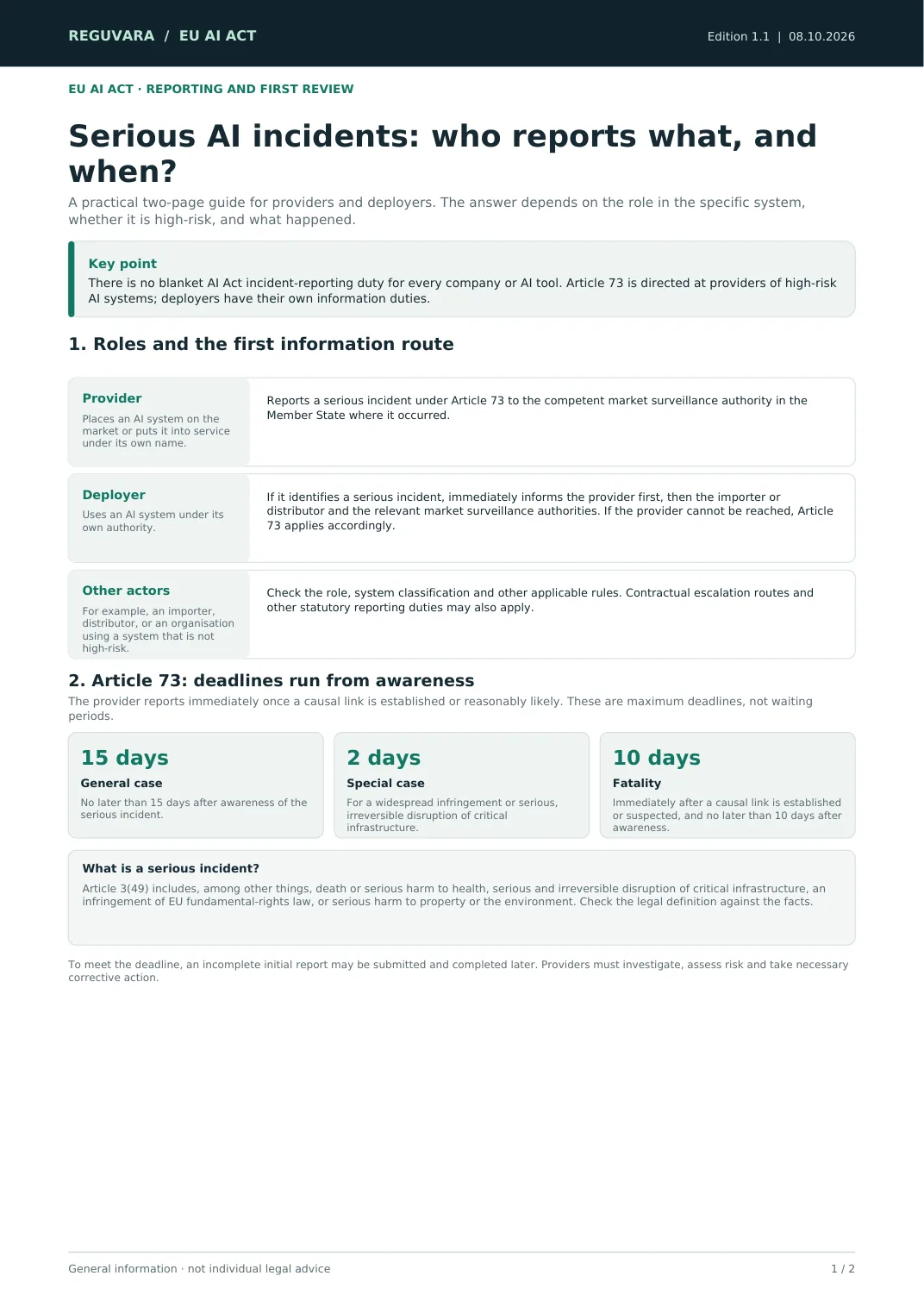
Providers of high-risk AI systems must report serious incidents to the competent market surveillance authority. Deployers have their own immediate information duties when they identify one. Know the role, trigger, deadline and evidence before time pressure begins.
Choose a kit tier and language. The shop shows only editions with active Stripe checkout and a verified private download.
Free
0 €free
A concise first reference for serious incidents and team response.
Sprint
179 €one-time
A practical starter package for a structured readiness process.
Available languages (11): Deutsch, English, Français, Nederlands, Português, Ελληνικά, Čeština, Polski, Italiano, Español, Slovenščina
Premium
349 €one-time
A broader compliance package with guides, templates, checklists and working materials.
Available languages (10): Deutsch, English, Français, Nederlands, Português, Română, Ελληνικά, Čeština, Polski, Italiano
The AI Act does not impose one blanket incident-reporting duty on every company or AI tool. System classification, your role and the event matter. A clear first assessment helps teams act without losing time over ownership.
Article 73 requires providers to report serious incidents to market surveillance authorities. A prepared process connects detection, causal assessment, notification, investigation and corrective action.
Deployers monitor high-risk systems. If they identify a serious incident, they must immediately inform the provider first, then the importer or distributor and relevant authorities as required.
Management, compliance, product, IT, HR, procurement and privacy teams need one escalation route. An AI inventory shows whom to contact and which facts to preserve.
Regulation (EU) 2026/1744 (the AI Omnibus) adjusted the timetable for key high-risk obligations. Other AI Act provisions already apply on their own schedule.
Prohibitions on certain practices, general-purpose AI rules and other provisions have separate application dates. Check each system and role against the current law.
A shared, rehearsed process makes responsibilities and information gaps visible before an incident or review demands urgent coordination.
Record purpose, provider, internal deployers, model dependencies and affected business processes.
Document the system, context and operator role; assess high-risk and transparency questions.
Assign detection, escalation, provider contact, authority communication and evidence preservation.
Record owners, deadlines, corrective measures, approvals and decisions for each system.
Choose an EU AI Act kit tier and language. The shop enables purchase only for editions with a verified Stripe checkout and matching private download. Your selected language package is released privately after payment is confirmed.
 Page 1 of 2 · select to open the PDF
AI Act reporting quick guide
A quick view of provider and deployer responsibilities and the Article 73 reporting periods.
Open the complete 2-page guide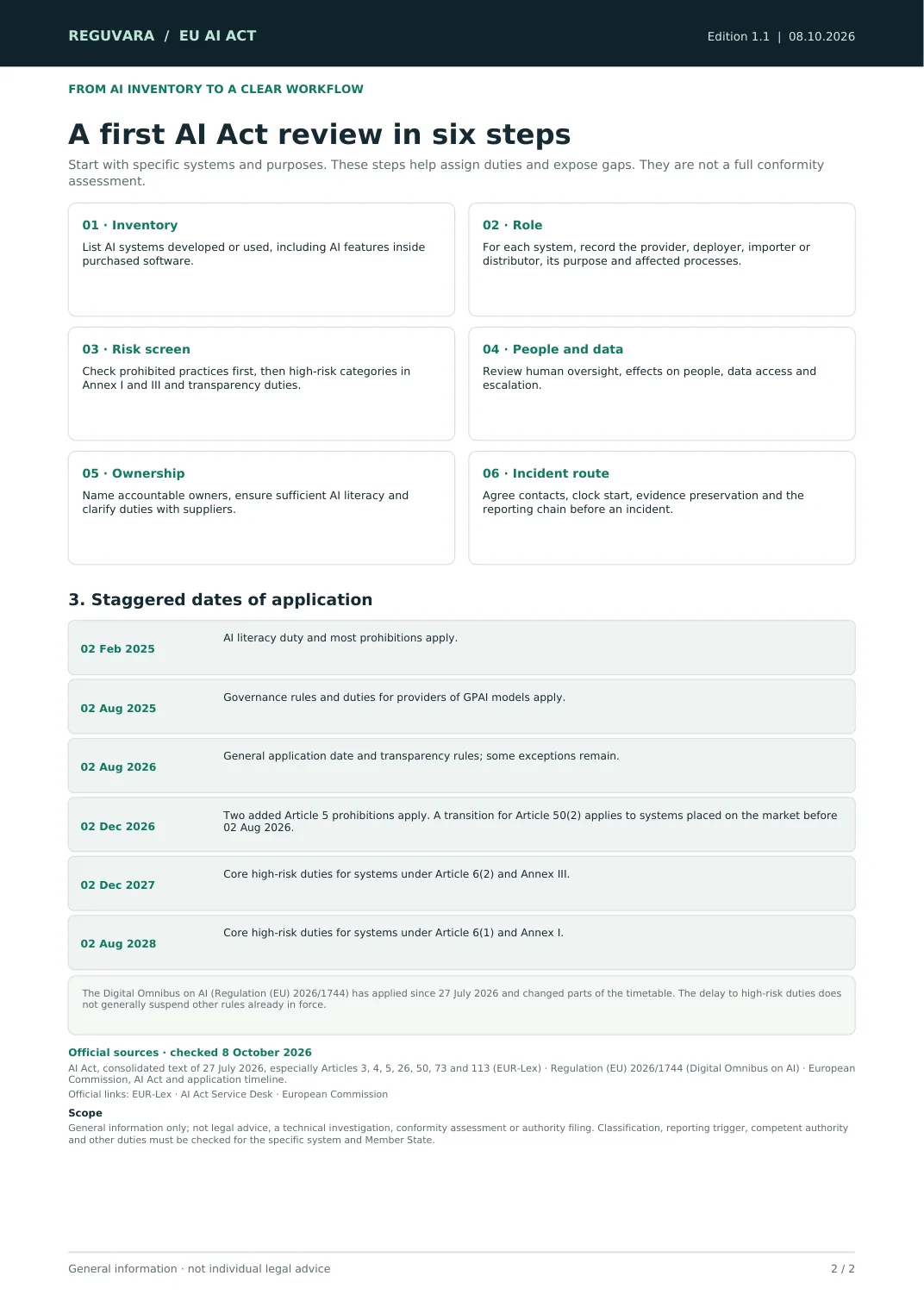 Page 2 of 2 · select to open the PDF
AI Act reporting quick guide
A practical starting structure for your inventory, roles, classification and next actions.
Open the complete 2-page guideSources checked 13 November 2026. The current consolidated legislation, relevant guidance and actual system context prevail.
Start with the company’s role in the specific use case and the system category involved.
No. Article 73 addresses providers of high-risk AI systems and serious incidents. Deployers have monitoring and immediate information duties when they identify one. The exact duty depends on the role, system and event.
Reporting must be immediate once a causal link or reasonable likelihood is established. In any event, the maximum is 15 days after awareness; two days for specified widespread cases and ten days where a person dies. Verify the exact trigger and classification.
The amended timetable sets 2 December 2027 for relevant Annex III systems and 2 August 2028 for certain AI integrated into regulated products. Other AI Act rules have separate dates.
No. It is not a conformity assessment or legal advice. It helps organise system information, roles, open issues, actions and evidence.
The paid AI Act kits are complete and available in the shop. Choose your language there; the private file is provided after payment is confirmed.
Ask us about the guide, product scope or availability.